From Rain Forecasts to Lottery Tickets: How Chance Shapes Daily Decisions
Most of us left probability behind in high school, somewhere between coin tosses and bags of coloured marbles. Yet we use it every single day: deciding whether to take an umbrella, choosing an insurance deductible, reading a medical test result or buying a lottery ticket. You do not need formulas to get better at these decisions. A handful of plain ideas will take you most of the way.
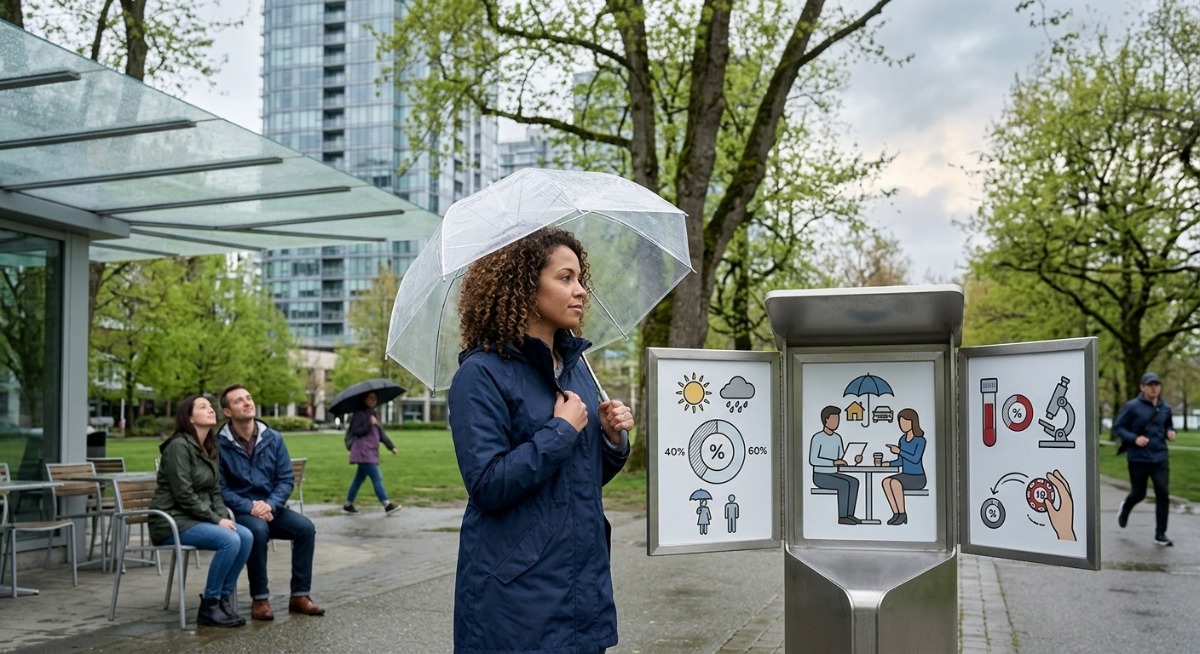
The basics in one minute
A probability is a number between 0 and 1, or between 0 and 100 per cent. Zero means impossible, one means certain, and everything interesting lives in between. A fair coin landing heads has a probability of 0.5, or 50 per cent.
People often confuse probability with odds. Odds compare the chances of something happening with the chances of it not happening. Odds of 3 to 1 against mean three ways to lose for every way to win, which is a probability of 1 in 4, or 25 per cent. Sports betting lines, horse races and casino tables all use odds, so it helps to translate them back into simple percentages.
What a 40 per cent chance of rain really means
Weather forecasts are probably the most common probabilities we see. In Canada, the probability of precipitation describes the chance that a measurable amount of rain or snow will fall at any given point in the forecast region during the period. It does not mean it will rain for 40 per cent of the day, or over 40 per cent of the area.
The practical takeaway: at 40 per cent, rain is less likely than not, but common enough that you would be caught out on about two days in five with no umbrella. Whether you carry one depends on the cost of being wrong. A dress shirt before a job interview? Take it. A quick walk to the corner store? Probably fine without.
Expected value: the idea behind smart decisions
Expected value means multiplying each possible outcome by its probability and adding them up. It tells you what a choice is worth on average if you could repeat it many times.
Consider an extended warranty on a $300 appliance that costs $60. If there is roughly a 10 per cent chance it breaks during the warranty period and a repair costs $150, the expected cost of going without is about $15. Paying $60 to avoid an expected $15 is a poor deal on average, which is why warranties are profitable for retailers. Insurance on your house is different: the loss would be catastrophic, so paying more than the expected value makes sense to avoid ruin.
Medical tests and the base-rate trap
Suppose a condition affects 1 in 1,000 people and a test is 99 per cent accurate. You test positive. What are the chances you have it? Most people guess 99 per cent. The real answer is closer to 9 per cent.
Picture 100,000 people. About 100 have the condition, and the test catches 99 of them. Of the 99,900 healthy people, 1 per cent, or 999, also test positive. So out of 1,098 positive results, only 99 are true. This is why doctors confirm surprising results with a second test, and why the base rate, meaning how common something is to begin with, matters so much.
Independence: why streaks do not predict the future
A fair coin has no memory. After five heads in a row, the chance of heads on the next toss is still 50 per cent. Events like this are called independent, and our brains struggle with them. We see patterns everywhere and assume a run must be due to end or due to continue.
Casino games follow the same rules of independence and long-run averages. Past rounds tell you nothing, so in crash games each aviator game bet is settled on its own, and a 97 per cent return to player means about $3 of every $100 wagered stays with the house.
Lotteries and very small numbers
The odds of winning the Lotto 6/49 jackpot are about 1 in 14 million. Numbers that small are almost impossible to picture. One way to feel them: if you bought one ticket every week, you would expect to wait well over 200,000 years for a jackpot. That does not mean you should never buy a ticket. It means the ticket is the price of a few days of daydreaming, not a plan.
Small samples can fool you
A new restaurant with two five-star reviews is not necessarily better than one with 400 reviews averaging 4.5. With small samples, luck dominates. The same goes for a friend who always seems to win at cards after three games, or a stock that doubled in a month. Before drawing conclusions, ask how many observations sit behind the claim. The more data, the more the average can be trusted.
Why we fear the wrong risks
People routinely overestimate dramatic, vivid risks such as plane crashes or shark attacks and underestimate everyday ones such as driving or a sedentary lifestyle. Media coverage and memorable stories distort our sense of how common something is. A useful habit is to ask: how often does this actually happen, per trip, per year or per person? Looking up the base rate often calms needless fear and redirects attention to risks that deserve it.
Five habits for better everyday judgment
- Translate odds and fractions into simple percentages or counts out of 100.
- Ask what the outcome costs if you are wrong, not just how likely it is.
- Use expected value for repeated decisions, and insurance logic for rare disasters.
- Check base rates before reacting to a test result or a scary headline.
- Remember that independent events have no memory.
The takeaway
Probability is not just a school subject. It sits behind forecasts, prices, medical advice and every game of chance. With a few core ideas, such as expected value, base rates and independence, you can read the numbers around you more clearly and make calmer, better-informed choices.